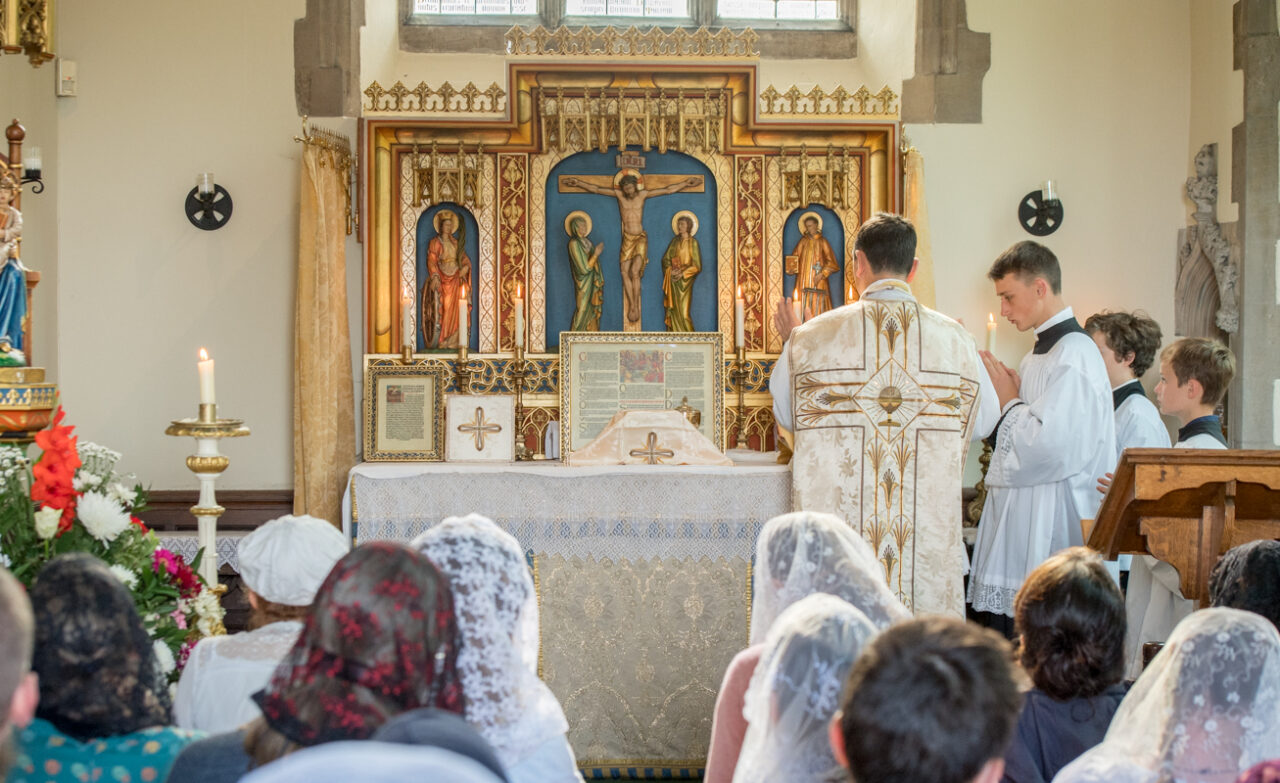
A Dialogue Mass is a form of the Low Mass in which the congregation makes some or all of the spoken responses aloud together, instead of leaving them entirely to the server.
What defines a Dialogue Mass
In a traditional Low Mass, the priest recites the prayers quietly while the server alone gives the responses on behalf of the people. In a Dialogue Mass, the faithful are encouraged to respond verbally at certain points, such as:
- Et cum spiritu tuo
- The responses at the Confiteor
- The Sanctus and Agnus Dei
- Sometimes even the Domine, non sum dignus
Importantly, the Mass remains a Low Mass: there is still no chant, no deacon or subdeacon, and no sung Propers or Ordinary.
Historical background
The Dialogue Mass arose in the early 20th century, particularly in parts of France, Germany, Belgium, and later the United States, influenced by the Liturgical Movement. Pope St. Pius X encouraged greater understanding of the liturgy, and Pope Pius XI and Pius XII later permitted limited forms of congregational responses in Low Masses.
The practice was never mandated and was regulated by rubrical permissions, notably in Mediator Dei (1947). Even at its height in the 1940s–1950s, the Dialogue Mass was optional and unevenly adopted.
Traditional evaluation
Traditional liturgical commentators – and priests of communities such as the FSSP – often note that the Dialogue Mass was an experiment, not an organic development of the Roman Rite. Critics argue that it blurs the distinct liturgical roles of priest, server, and congregation, and can distract from the contemplative silence that characterizes the Low Mass.
Key point
A Dialogue Mass is not a separate form of Mass. It is simply a Low Mass with spoken congregational responses, permitted but never required, and today rarely used in traditional Latin Mass communities.
Leave a Reply